

Choosing the right camera for a Safari in Tanzania can transform your trip into an extraordinary photographic experience. With the vast plains of the Serengeti, the exceptional wildlife of the Ngorongoro Crater and the Great Migration, Tanzania offers unique photo opportunities that require equipment adapted to field conditions.
Going on a photo safari in Tanzania requires careful preparation of your equipment. Between the omnipresent dust, early morning and evening low light, and constantly moving animals, your camera must meet specific requirements to capture those magical moments you may only experience once in your life.
Why choose the right camera for a safari in Tanzania?
A safari in Tanzania presents unique photographic challenges not faced by other destinations. The best photos are taken at 80% in low light, while the vehicle is on game drive. Dust is omnipresent in Tanzania’s national parks, especially during the dry season, and can damage your equipment if it is not adapted.
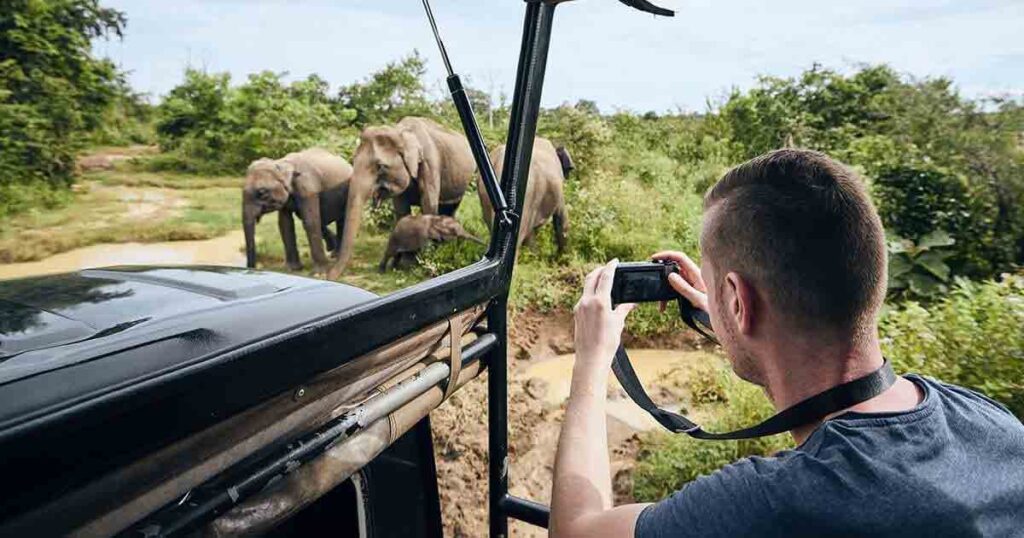
Animals move a lot, all the time! Never forget that the car is moving (either you’re not alone, or you’re driving). This reality of game drive in Tanzania calls for a device capable of efficiently handling vibrations and movements.
Safari Avventura, with over 10 years’ experience in Tanzania, accompanies passionate photographers in their photo projects. Our expert guides know the best spots for wildlife photography and adapt tours to the technical constraints of your cameras.
Defining your photographic objective in Tanzania
Before buying or renting your equipment, define your photographic expectations precisely. Don’t expect to take a portrait of the animal. You need to compose differently and take a photo of the animal in its ecosystem, particularly in the vast spaces of the Serengeti National Park.
Wildlife vs. landscape vs. family photos
For wildlife photography: opt for long focal lengths (300mm minimum) and excellent ISO settings. The Big Five – lion, leopard, elephant, rhinoceros and buffalo – require specific settings depending on the time of day and animal behavior.
For landscapes: A wide-angle lens is essential for capturing the immensity of craters and plains. Wide angle (e.g. 16-35 mm) for landscapes, craters, large scenes.
For family memories: a versatile bridge camera may suffice, with an extended zoom to adapt to different situations without changing lenses in the dust.
What kind of cameras are needed on safari?
Your choice of camera for a safari depends on your budget, your technical level and your photographic objectives. Each type of camera offers specific advantages for Tanzanian conditions.
Which SLR camera to choose?
The SLR is more for the enlightened amateur, who knows how to juggle diaphragm, depth of field and exposure metering. The SLR is almost immediately in action, and the latency between triggering and shooting is extremely short.
Advantages of SLRs on safari :
- Immediate responsiveness and high-performance autofocus
- Extended lens range (14-800mm)
- Excellent management of high ISO sensitivities
- Latency-free optical viewfinder
Recommended models :
- Canon EOS 5D Mark IV: The professional standard (€2500)
- Nikon D850: Canon’s direct competitor (€2500)
- Canon EOS 250D: excellent value for money for beginners (€600)
Disadvantages: Heavy weight with telephoto lenses, high power consumption, sensitivity to dust when changing lenses.
Which hybrid camera is right for you?
Today’s full-frame hybrids offer excellent image quality with the advantage of reduced weight and size compared to SLRs – an asset when traveling or on safari.
Advantages of hybrids :
- Reduced weight and footprint
- As capable as the best SLRs, they feature interchangeable lenses and all the refinements of SLRs, often with greater sensitivity.
- Electronic viewfinder with preview of final result
- Advanced video functions
Recommended models :
- Sony Alpha 7III: Sony Alpha 7III and several lenses: the 16-35mm for landscapes, the bright 50mm (f/1.4 aperture) for evening scenes.
- Canon EOS R6 Mark II: High-performance hybrid for wildlife photography
- Nikon Z7II: Quality Nikon alternative
Which bridge camera to choose?
ou need a bridge camera with a 1″ sensor (best for low light). Ideal for those who want simplicity, versatility and a powerful zoom without breaking the bank.
Top 3 safari bridges :
| Model | Price | Focal length | Aperture | Highlights |
| Panasonic Lumix FZ300 | 400€ | 25-600mm | F2.8 constant | Panasonic Lumix FZ300 (400€ new), tropicalized |
| Sony RX10 IV | 1800€ new | 24-600mm | F2.4-4 | the best bridge camera in the world! |
| Panasonic Lumix FZ1000 II | 650€ | 25-400mm | F2.8-4 | Panasonic FZ1000 II (650€ new) |
SLR, bridge, hybrid: what to choose for a safari?
For beginners on a tight budget (under €1,000): go for a bridge like the Panasonic Lumix FZ300. If you don’t want to spend too much, under €1,000 new, in that case you need a bridge with a 1″ sensor.
For enthusiasts (€1,000-3,000): A hybrid or APS-C SLR with 70-300mm or 100-400mm telephoto lens.
For experienced photographers (over 3000€): DSLR or full-frame hybrid with professional lenses. Entry-level Canon 100/400 LIS at €1,600 for zoom alone is the minimum, while less expensive SLRs are not specifically suited to safari photography.
Essential photo accessories for a successful safari
Recommended lenses and focal lengths
Essential focal points:
- Wide-angle 16-35mm: Landscapes and wide-open spaces
- Standard 24-105mm: Versatile for different situations
- 100-400mm telephoto lens: Telephoto lens (e.g. 100-400 mm) – the most widely used wildlife lens on safari.
F5.6 at 400mm will be the worst aperture and just acceptable for a good photographer, and F4 or 4.5 will be an excellent compromise. Avoid F6.3 or F8 lenses, which lack brightness.
Bean bag and stabilization
The bean bag, or even the cap, not just accessories! The bean bag is crucial for stabilizing your camera on the edges of the Safari vehicle. Forget the tripod – it’s useless for dynamic shots, as you’re shooting from the moving vehicle.
Protection and care
Equipment protection checklist :
- Dust-proof bags
- UV protective filters (optional, depending on preference)
- Use of the sun visor is mandatory
- Blowgun for lens cleaning
- Microfiber cloths
| Accessory | Utility | Approx. price |
| Bean bag | Vehicle stabilization | 20-40€ |
| UV filters | Forehead protection | 30-80€ |
| Sun visor | Mandatory, contrast | 15-30€ |
| Fast memory cards | Bursts, 4K video | 50-150€ |
Small budgets, rental, second-hand: optimize your equipment budget
Solutions for tight budgets
Equipment rental: Consider renting a professional telephoto lens rather than buying one. A Canon 100-400mm or Nikon 80-400mm costs €80-120/week to rent.
Second-hand market: older-generation bridges like the Sony RX10 III are still excellent, and can be found for around €800 on the second-hand market.
Budget priorities :
- Long focal length (300mm minimum)
- Optical stabilization (not just digital)
- Maximum F4 aperture (avoid F5.6+)
- Correct ISO rise (up to ISO 1600-3200)
Safari Avventura benefits for your equipment
Our experienced guides will advise you on the optimum settings for the conditions. Photo vehicles with electrical outlets for recharging batteries and bean bag holders.
On-site services :
- Pre-departure equipment advice
- Technical assistance on safari
- Safari vehicles equipped with 12V/USB sockets
- Guides trained in photographic constraints
Tips from the field: successful photography on safari in Tanzania
Recommended safari settings
Safari basic settings :
- Speed priority mode for moving animals
- Automatic ISO capped at 1600-3200 depending on camera
- Minimum speed 1/250s to avoid motion blur
- Continuous autofocus (AI Servo/AF-C) for moving subjects
ISO generally low thanks to sunlight, except at dawn/sunset. Increase your camera’s sensitivity (ISO number) if it’s not automatic on your camera, but don’t go beyond ISO 800 (unless you’ve mastered it).
Key moments and light management
Game drives (searching for animals at low speed) take place between 6:30 and 9:30 in the morning and between 3:30 and 6:00 in the evening. These times offer the best light, but also the greatest technical difficulties.
Golden hours on safari:
- 6:30-9:30: Sunrise, golden light, active animals
- 15:30-18:00: Sunset, a magical atmosphere
- Avoid 11:00-15:00: the light will be too white and the animals’ eyebrows will cast shadows over their eyes
Photographing animals in motion
On safari, the car is moving and you only have 2 to 4 seconds to release the shutter, so do as I do, shoot a short burst first and then think about it.
Shooting technique :
- Burst mode activated (6-10 images per second minimum)
- Single AF point on the animal’s eye if possible
- An experienced amateur or a professional photographer will always want the eyes to be bright, not black.
- Anticipation of movements thanks to the guide’s experience
SLR, bridge, hybrid: what to choose for a safari?
Safari Avventura guide tips :
- Shoot as soon as the subject appears, even in moving vehicles
- Use the bean bag systematically for stability
- Always choose high resolution, because lowering the resolution will be easy, but increasing it will be IMPOSSIBLE!
- More memory cards than one big one
Common mistakes :
- Lens too close (F5.6+) = blurred photos
- Forgetting the sun visor = loss of contrast
- Changing lenses in the dust = dirty sensor
- Batteries not protected from night-time cold
Configuration examples and real-life testimonials
Beginner configuration (800€)
Recommended kit:
- Panasonic Lumix FZ300 (400€)
- Fast SD cards + batteries (100€)
- Bean bag + protective accessories (50€)
- Waterproof camera bag (50€)
Passionate amateur configuration (€2,500)
Hybrid setup :
- Sony Alpha 7III (1500€)
- 100-400mm F4.5-5.6 lens (800€)
- Wide-angle 16-35mm F4 (200€)
Professional configuration (5000€+)
Expert kit :
- Canon EOS R5 (3500€)
- Canon RF 100-500mm F4.5-7.1 (2700€)
- Canon RF 16-35mm F2.8 (€2500)
Professional photographers choose Safari Avventura for our guides’ expertise in the field and our photo vehicles with specialized supports.
Feedback from the field
Canon 5D3 and 7D, lens: Sigma 120-300 F2.8 OS Sport (great once configured), X1.4 and X2.0 sigma, canon 70-200F4 L. Distances vary a lot, but in Tanzania there’s a lot of savannah.
Lessons from our customers :
- Multipliers reduce brightness = avoid if possible
- Full-frame vs. APS-C: crop factor helps wildlife photography
- Optical stabilization essential, digital insufficient
FAQ: Everything you need to know before buying a camera for a safari in Tanzania
Which SLR camera should you choose for a safari in Tanzania? For beginners: Canon EOS 250D or Nikon D3500 (600-700€). For enthusiasts: Canon 5D Mark IV or Nikon D850 (2500€). Prioritize high ISO and high-performanceautofocus.
Which hybrid camera for wildlife photography? The Sony Alpha 7III remains the benchmark for quality/price. If you don’t yet have your own camera, I’d advise you to opt for a hybrid camera, which will enable you to make faster progress in photography.
Should I choose a bridge or an SLR for a safari? A bridge camera will almost always be the best choice in terms of value for money for beginners. Experts will prefer an SLR or hybrid with dedicated lenses.
What basic settings should I use on safari in Tanzania? Shutter-priority mode, ISO auto capped according to camera, shutter speed 1/250s minimum. Sufficient shutter speed whenever there’s movement (shutter priority/fast range).
What’s the budget for a safari camera?
- Tight budget: €400-800 (high-performance bridge)
- Enlightened amateur: €1,500-3,000 (hybrid/reflex + telephoto lens)
- Expert/professional: €5,000+ (top-of-the-range equipment)
Is it possible to rent photographic equipment for a safari? Yes, renting makes sense for expensive telephoto lenses. Count on €80-120/week for a professional 100-400mm. Safari Avventura can direct you to reliable rental companies.
How do you protect your equipment from dust? Use waterproof bags, avoid lens changes, use protective UV filters. A simple bag to protect your equipment from dust and humidity is also a good idea.
Go further: tailor-made photo tours with Safari Avventura
Why choose Safari Avventura for your photo safari?
Safari Avventura, a specialist for over 10 years, organizes tailor-made photo safaris in Tanzania. At Safari Avventura, we’ve been creating tailor-made holidays for over 10 years, combining the intensity of wildlife with expert photographic guidance.
Our unique advantages :
- Multilingual guides trained in photo constraints
- Vehicles equipped with electrical outlets and bean bag holders
- Flexible circuits for the best light hours
- Small groups (maximum 7 people) for greater efficiency
- Secure logistics with backup equipment
Recommended photo tours
Photo Safari Serengeti + Ngorongoro (7 days) Specially designed for the Great Migration and the Big Five. Optimized timing for wildlife photography.
Photo Safari + Zanzibar Extension (10 days) Combine wildlife photos on safari and landscape photos on the beaches of Zanzibar.
Expert Photo Safari (14 days) Complete tour including Tarangire, Serengeti, Ngorongoro and Lake Manyara with specialist photo guides.
Photo accompaniment services
- Field coaching adapted to your equipment
- Secret spots known to our local guides
- Technical assistance for hardware problems
- Post-processing: tips for enhancing your images
- Optimum timing according to seasons and migrations
Safari Avventura guarantees: everything is organized from A to Z: transfers, internal flights, English-speaking guides, hotels selected for their quality.
Safari Avventura opening hours: Monday to Sunday: 08:00-19:00
Internal networking and complementary resources
- Safari Tanzania and Zanzibar: Our combined tours
- Tanzania National Parks: Complete destinations guide
- Practical safari guides: Preparing for your trip
- When to go to Tanzania: Optimum calendar
- How to behave on safari: Ethics and safety
Safari Avventura, your trusted local partner for a successful photo safari in Tanzania.
Ready to immortalize the majesty of Africa? Your Safari Tanzania camera is waiting for you, and our expert guides are there to accompany you on this unforgettable photographic adventure. From selecting your equipment to optimizing your settings in the field, Safari Avventura transforms your passion for photography into exceptional memories.