

The Black Mamba snake(Dendroaspis polylepis), also known as the Seven Steps, has a terrible reputation: being one of the most venomous snakes in the world and the most venomous snake in Africa. The nickname Seven Steps derives precisely from its lethality: one bite from it does not allow a human to take more than 7 steps before dying.
The Black Mamba is also the fastest land snake in the world, as well as “the longest species as a venomous snake in Africa and the second longest in the world, “ as told by Sara Viernum, a herpetologist based in Madison, Wisconsin. The great potential danger of this snake has been the subject of many African myths and has been the cause of thousands of human deaths.
Discovering the Black Mamba
The Seven-Step is an extremely toxic and very fast snake, is highly aggressive when it feels threatened, and is known to strike repeatedly by injecting a large amount of venom with each strike. Its venom is potentially lethal and, although an antidote exists, it is not widely available in southern and eastern Africa. For this reason, it is considered a killer in a land where nearly 20,000 people die from snakebite each year.
Features
Contrary to what its name suggests, the black mamba is actually brown in color, but it can be olive or have grayish tones. In fact, this dangerous snake is called black mamba not because of the pigmentation of its skin, but because of the coloration of the inside of its mouth, which is a deep inky black. Similar to Agkistrodon piscivorus (water moccasin), when threatened a mamba opens its mouth to show the black lining as a warning sign.”
The Black Mamba has a coffin-shaped head and is a particularly agile and fast snake. According to National Geographic, these snakes can grow to be 14 feet (4.25 m) long, although their average length is about 8 feet (2.4 m). These giants can live up to 11 years.
Habitat
The black mamba resides in southern and eastern African savannas, in rocky hills and open woodlands, according to the University of Michigan Museum of Zoology’s Animal Diversity Web (ADW). They like to be in open spaces and sleep in hollow trees, rock crevices, burrows or empty termite mounds.
Habits
These fast snakes can move faster than most people can run, a fact that partly explains why they are so feared. In the words of herpetologist Viernum, “the black mamba is one of the fastest species in the world, which can reach speeds of more than 20 km/h.” Over long distances, however, they can maintain an average of about 11 kmh).
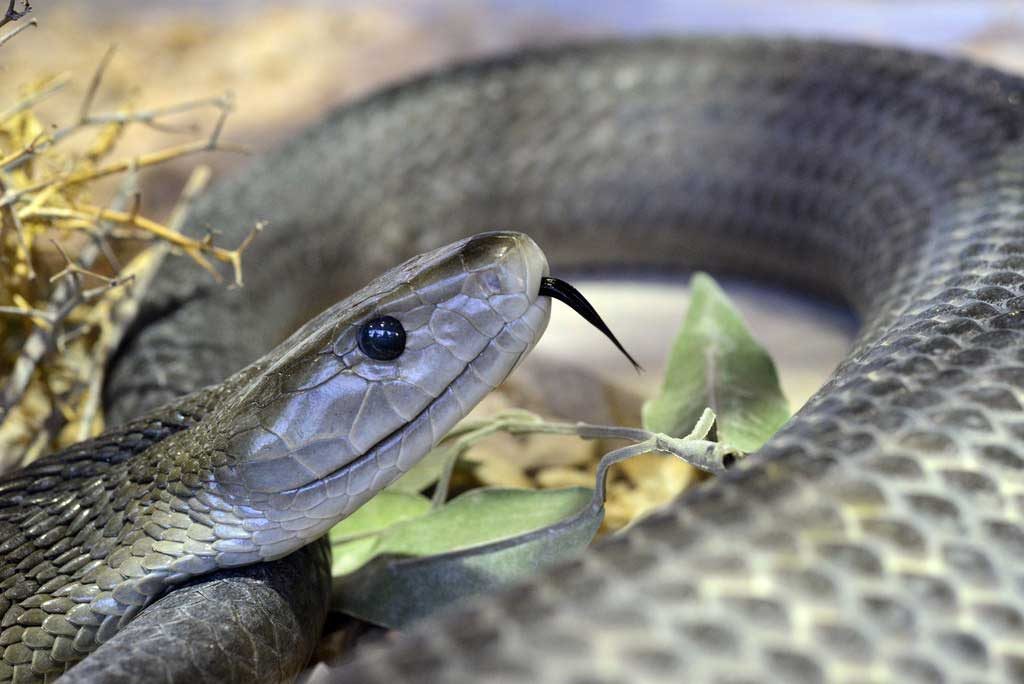
They glide swiftly in short bursts over flat ground, and can stretch about a third of their bodies off the ground while holding their heads high with pride. The mamba’s run is a terrifying and astonishing sight. However, according to National Geographic, the snake uses its incredible speed to escape threats, not to attack.
The black mamba is very active during the day and returns to the same place each night to sleep. According to the big-screen ARKive Initiative, it is often seen “basking in the branches of a tree early in the morning” before hunting. Black mambas are sometimes found in pairs or small groups, although Viernum emphasizes their fundamental shyness . He said they are, “shy and secretive snakes that prefer to escape confrontation. “
However, “black mambas can become very aggressive when threatened. Their defensive behavior is their most distinctive characteristic.”
“When severely threatened, these snakes raise their upper bodies off the ground to stand,” Viernum said. This is a defensive posture in order to scare off the threat. If the Black Mambasnake needs to attack in order to defend itself, it will not think twice: it will inject large doses of venom with each strike, and it will hiss loudly and then slither away as fast as possible.
Diet
The Black Mamba typically eats small mammals and birds, although according to Blue Planet Biomes, there have been reports of mambas found with whole parrots or cobras in their stomachs. In his book ‘Black Mamba’ , Adam G. Klein wrote that on the hunt the snake bites its prey by injecting venom, releasing it later and following it until the prey becomes paralyzed and dies, at which point it eats it.
Usually the prey does not stay alive long after being bitten by a black mamba. These snakes year flexible jaws that can displace and adapt to food up to four times the size of their heads.
Reproduction
According to the University of Wisconsin-La Crosse BioWeb, this dangerous snake usually mates during the spring or summer. Males fight for the affections of females. After mating, females lay between 6 to 25 eggs in a moist, warm burrow. The female leaves her eggs and never sees them again. The pups hatch about three months later and are born measuring between 16 and 24 inches.
Bite and poison
With two drops of venom the powerful black mamba can kill a human being, according to South Africa’s Kruger National Park. The venom of this snake, similar to the cobra and coral snake, contains neurotoxins and has an LD50 of 0.25 mg/kg, as reported by herpetologist Viernum. The venom shuts down the nervous system and paralyzes victims in a very short time, and without an antidote, the mortality rate from a black mamba bite is 100 percent. “Deaths from Black Mamba bites have been documented to occur no more than 20 minutes after injection. However, most known fatalities have occurred within 30 minutes to 3 hours or more.”
Taxonomy/classification
The black one is one of the four mamba species, according to the Integrated Taxonomic Information System (ITIS). Others are Jameson’s mamba, eastern green mamba and western green mamba. This snake is a member of the Elapidae family, like the coral snake and the cobra. Mambas are slender, agile and active, with smooth scales and a powerful venom. They all live throughout sub-Saharan Africa.
More Mamba
The other mamba species are all smaller and somewhat less venomous than the black one. These snakes are all bright green. They are also arboreal species and therefore resident in trees. They are known to fall from branches onto their prey. They are all solitary snakes.
Jameson’s Mamba
This is a slender snake that lives in trees and actively and rapidly pursues its small prey during the day. It can grow up to 8 feet (2.4 m) and lives in West and Central Africa.
Eastern Green Mamba
This is the smallest mamba, usually measuring about 6 or 7 feet (1.8 to 2.1 m). It is common in forests throughout East Africa.
Green Mamba of West Africa
Also known as the western green mamba or Hallowell’s green mamba, this snake can reach 10 feet (3 m), according to Branson Wild World. It is the second longest and most venomous snake in Africa, after the black mamba. As its name suggests, it lives in West Africa.

Discover the best of a Safari in Tanzania with our 9-day package