

The black rhinoceros (Diceros Bicornis), or hooked rhinoceros, is a perissodactyl mammal of the African lowland regions, most common in the areas of Botswana, Kenya, Cameroon, South Africa, Zimbabwe, Namibia, Malawi, Mozambique and, of course, our beloved Tanzania. Because of its size and aggressiveness, it has been included within the Big Five, Africa’s five largest animals, and is one of the most beautiful animals to see on a Tanzanian safari.
The Black Rhinoceros belongs to the family Rhinocerontidae, which made its appearance in the Eocene period, about fifty million years ago. The division between black rhinos and white rhinos began to occur, however, in the late Miocene, ending 4 million years ago.
Although its name is reminiscent of the color black, this designation was actually given for quite different reasons. The white rhino was named so because of a misinterpretation of the word wyd, which, in Afrikaans, means wide, and not white as the British thought. Hence the distinction of rhinos by color and not by size.
Description and physical characteristics
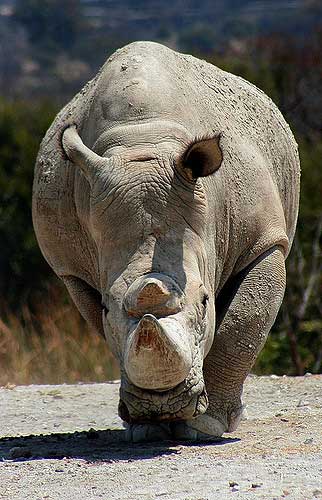 The hooked rhinoceros is a unique animal. Its height ranges from 140 to 180 cm at the withers (that is, up to the shoulders), while its length is around 3.5 m. An adult male can weigh up to 1,400 kilograms while an adult female weighs about 100 kilograms less than the male while maintaining the same size.
Diceros Bicornis, as can be guessed from their scientific name, possess two horns. The first horn is also the most extensive in length and can reach up to 140 cm. The second horn is smaller and is flattened. In some exceptional cases it may even sprout a third, which will be very small in size.
The horns of the African rhinoceros are made of keratin and have numerous functions: they serve for defense and protection, intimidate enemies and are very useful for feeding. Using them, the black rhinoceros can dig for water and roots and to break branches off shrubs.
Another important feature are their ears: they are mobile and allow them to hear at great distances. They are also critical to their survival, as these animals do not have good eyesight and must rely primarily on hearing and smell to sense the presence of any predators.
The upper lip of the black rhinoceros is triangular and prehensile, this is because it has to reach out to the leaves and tear them from their tree.
Their armor can be different colors, ranging from brown to dark gray. It is thick and rough as it consists of many layers that help the animal protect itself from the thorny shrubs typical of its natural habitat. Their skin, moreover, is full of parasites such as fleas and ticks that serve as food for birds such as buphagus and egrets that often lie on the rhinos’ backs waiting for a chance to feast.
Difference between black and white rhinoceros
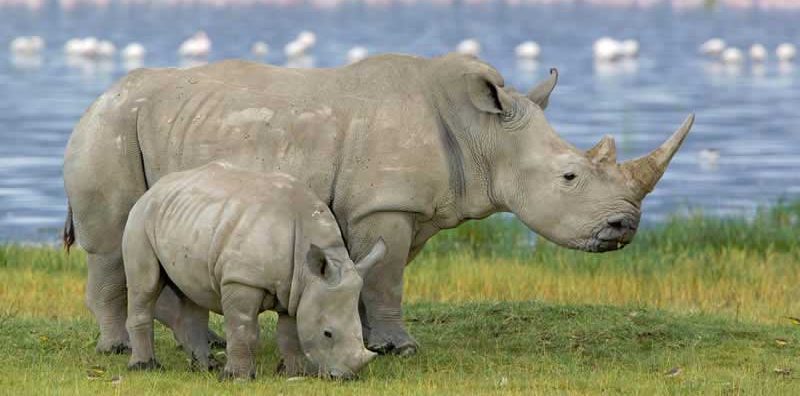
The differences between these two rhinocerontid species are many and quite obvious.
First, they differ in their size. While the adult black rhino can weigh up to 1400 kg, an adult white rhino weighs around 2400 kg.
The figure of black rhinos is leaner, smaller and more compact than its counterpart, which is wider and has a barrel-shaped body.
The back of white rhinos is flat, with a small protruding hump toward the end. That of black rhinos, on the other hand, is arched.
Their snouts are also completely different, and this is because of the diversity of their diets:
The black rhinoceros, as seen above, feeds on foliage from low bushes and trees. Because of this, it is used to holding its head high and, as a result, its neck muscles are stronger than those of the white rhinoceros. In addition, its mouth is triangular in shape and it has prehensile lips for pulling leaves off branches.
The white rhinoceros, on the other hand, feeds on grass. Its snout, therefore, is more elongated and its eyes smaller than those of the black rhinoceros. Its mouth is not triangular-shaped but square: its lips are large and flat and very muscular, suitable for tearing grass from the ground. If it portends a threat, the white rhino stays with its head down and uses its hearing to get to safety.
The ears are also a distinguishing mark that helps us distinguish the two species: the white rhinoceros has tall, tubular ears that it can move individually and uses satellites. Like all rhinos, in fact, its eyesight is not very good, and its nose turned toward the ground in search of food cannot deal with sniffing out predators.
The black rhinoceros, on the other hand, can rely on its sense of smell and sight to survive natural enemies, which is why its ears are smaller and rounder.
The front horn of the white rhinoceros is longer and more tapered than that of the black rhinoceros, while the reverse happens for the second horn.
Conservation and threats
For much of the twentieth century, black rhinos were the most numerous species among the rhinos. By 1900 there were hundreds of thousands in Africa.
Due to poaching and the gradual destruction of their habitat, their numbers have dwindled steadily, reaching a meager 2,500 in 1990.
Some specimens were taken to zoos in the U.S., where they easily adapted to the habitat and captivity.
In 2006, theInternational Union for Conservation of Nature recorded only 10 specimens of the West African black rhinos (Diceros Bicornis Longipes), and in 2011 they were declared experimentally extinct.
The other subspecies of black and white rhino are still at risk, despite the construction of sanctuaries and nature reserves where they can live in peace, away from predators and hunters.
The only type of African rhinoceros that seems to have been saved from the risk of extinction is the Southern African white rhinoceros.
But what caused these creatures to shrink so drastically in the ecosystem?
One little considered factor is that of the predators who, en masse, have been lashing out at the rhinos for years on end without control. Prominent among these is the figure of the lion.
Rhinos are herbivores, feeding mainly on foliage. With pollution and the gradual destruction of natural habitats, the percentage of iron in plants has increased, and although they have managed through evolution to learn to ingest as little as possible, this creates problems for them in the liver, spleen and small intestine. This problem is found not only by rhinos in the wild, but also by those kept in captivity.
Poaching has also challenged the survival of Diceros Bicornis, sought after for their horn. The hunting of black rhinos has been a widespread phenomenon since ancient times, particularly by Asian peoples, and has seen its worst in Africa with the establishment of the Big Five Game.
Rhino horn was used in traditional Chinese medicine, and many herbalists claimed its usefulness for awakening the sick from comas, performing exorcisms and increasing fertility in men and women.
In the 1970s, poaching increased because of the continued demand for horns that were used to make the Janbiya, an ornamental dagger that boys over the age of 14 used in Middle Eastern countries.
Is it extinct?
If the question is: Is the black rhino extinct?, the answer is no.
Despite being threatened and highly endangered, the black rhino is not yet extinct and has nearly 5,000 individuals.
What has unfortunately become extinct is a subspecies of Diceros Bicornis, or the western black rhinoceros. This type of rhinoceros was found in Sudan, Chad, Cameroon, Niger and Nigeria. Confirmation of the disappearance of Diceros Bicornis Longipes was given by the International Wildlife Conservation Unit in 2011.
However, other subspecies went extinct in earlier times, namely the northeastern black rhinoceros (Diceros Bicornis Brucii) that disappeared in the 20th century and, even earlier, the southern black rhinoceros (Diceros Bicornis Bicornis) that went extinct in 1850.