

The leopard(Panthera pardus) belongs to one of the five panther subfamilies and is the ultimate predatory feline. The leopard is found heavily in sub-Saharan Africa, and in East African parks, such as in Tanzania, but some of these mammals are also highly proliferated in sub-East Asia.
Leopards are on the IUCN Red List, which classifies them as a vulnerable species due to the loss of their natural habitat and subsequent fragmentation across the globe. In addition, these felines have always been hunted for their fur and for hunters’ personal pride, especially in a hunting competition known as the Big Five Game.
Characteristics of the leopard
Appearance
In proportion to other felines, the panthera pardus has relatively shorter legs and flatter hips than its relatives but this does not make it less robust. In fact, males can measure 60-70 cm in height, while females 55-65 cm.
The body length ranges from 90 to 190 cm, including the tail. It acts as a balance for the animal, both for walking and climbing trees and moving between them.
The weight of a male leopard is around 37 to 90 kg, while that of the female ranges from 28 to 60 kg.
These large differences between male and female specimens is due to natural sexual dysmorphia.
The leopard’s muscles are very large and very strong, especially their hind muscles that allow them to jump and climb trees where they will hide their prey to prevent larger predators such as the lion from stealing them.
Its limbs, though muscular, are short and and end in wide, powerful paws equipped with both pads, which help it move quietly and stealthily, and retractable claws that aid it in hunting.
The panthera pardus is the feline with the longest and sharpest claws, which help it in climbing. Its canines, on the other hand, are about 6 centimeters long.
The leopard’s skull is large and rounded but its muzzle is shorter than that of other panthers. Its neck is very short and muscular. His jaw is very muscular and he uses it to grasp and carry prey much larger than himself-.
The feline’s pupil is round, yellow in color. Its night vision is six times better than human vision, and it also excels among that of other predators.
Fur
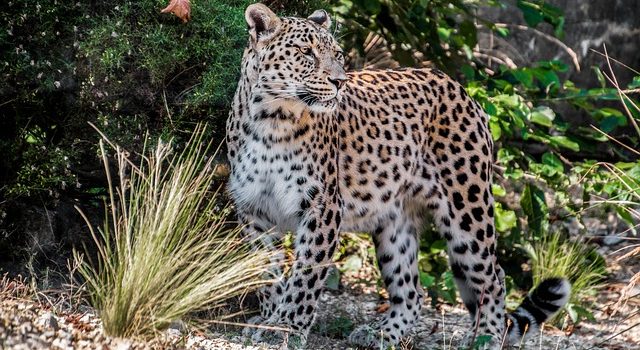 Leopards’ fur varies according to climate and where they are raised. Their coat can take various shades, from pale yellow to dark brown. The chest, belly, throat and tail are white, as is the inside of their paws.
The fur, on the flanks and back, has dark-colored rosettes called ocelli. The face also possesses spots. The legs, on the other hand, are characterized by less defined streaks that in the tail can turn into real rings.
The coat of these animals is short, shiny and thick, but soft. In contrast, the fur on the lower part is longer and fluffier than on the rest of the body.
Behavior
This superpredator is an animal that easily adapts to any type of habitat, which immediately becomes its territory. This can extend up to 400 km2 and includes one or two females.
Its activities mainly take place during the evening, when it is easier to blend in and act stealthily.
The panthera pardus hunts all kinds of animals, even those much larger than itself. In fact, it can go so far as to kill animals over 150 kg, in the absence of tigers or lions, its only rivals. This feline’s modus operandi is to jump at the necks of his prey and bite them, thus causing them to suffocate to death. Later, because of its strength and agility, the leopard climbs a tree where it can eat its meal away from other predators.
The leopard, however, is not just a predator. He too can be threatened by animals stronger than he is. In addition to the lion and tiger, his enemies include hyenas, wolves, wild dogs, prairie dogs, crocodiles, and bears.
It is one of the few large felines to be able to climb trees and descend from them while keeping its snout to the ground.
The leopard is a purely solitary animal and starts looking for a mate only during the breeding season, which takes place in January and February. The male stays with the female until just before giving birth and takes no part in family life. Gestation lasts a hundred days, and litters are usually of three to four individuals. Leopard cubs will begin hunting after three months of age and will stay with their mother until the next litter (usually occurring two years after the previous birth). Siblings will stay together for a few more months before separating.
Difference between African and Indian leopard
The African leopard, or panthera pardus pardus, is the most common subspecies of leopard and occupies the entire African area.
The Indian leopard, or panthera pardus fusca, is, however, a species classified as near extinction. It lives on the Asian continent and is continuously threatened by the progressive loss of its natural habitat and poaching.
Of these two types of panthera pardus, the larger is the African leopard, albeit by a small margin. In fact, it exceeds the Indian one in length by about ten centimeters.
The African leopard is also more familiar with climbing trees as it cohabits with predators such as lions and tigers. The Indian leopard, although living in Asian forests, has no one to compete with and often becomes an apex predator.
Differences can also be seen in the fur of these two animals. The African leopard usually has a dark yellow coat but, depending on its habitat, may take on cream or reddish-brown hues. The Indian leopard, on the other hand, has dark brown fur and, in the lower parts, light red. Both felines have black rosettes all over their coats.
Difference between cheetah and leopard
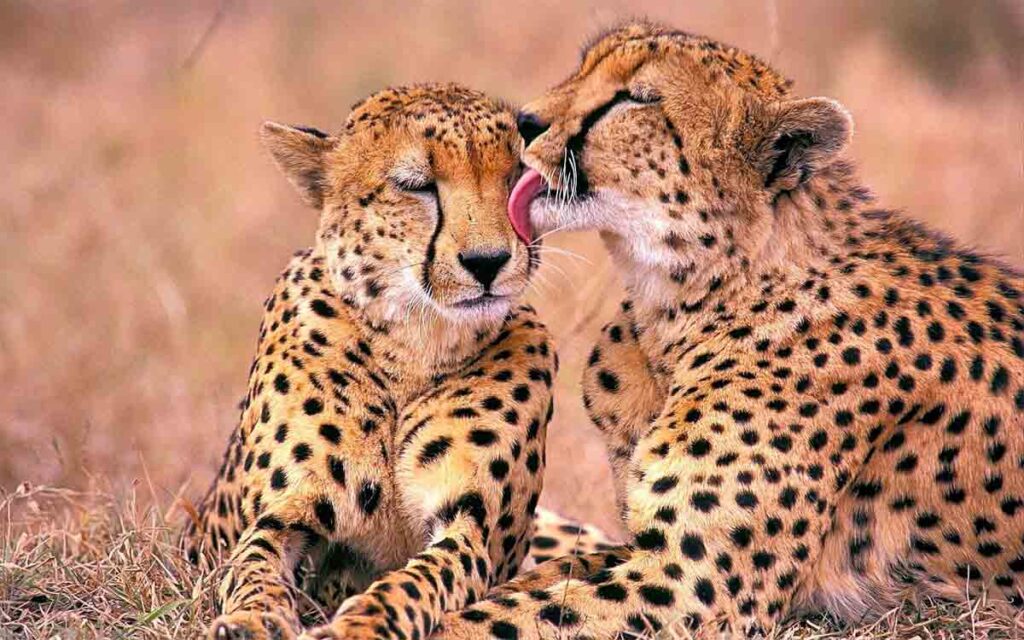
The differences between cheetah and leopard are countless, yet many people still fail to distinguish between these two felines.
First, the two predators differ in appearance. As we have already analyzed, the leopard’s fur is covered with dark rosettes. The cheetah, on the other hand, has a coat covered with circular spots. The snout of the latter, then, is covered with black streaks that start from under the eyes and reach the mouth.
The head is also different: the pathera pardus has a larger, rounder skull but a smaller nose. The cheetah, on the other hand, has larger nostrils, as it needs more oxygen to run.
The cheetah’s claws are also not retractable like those of the leopard, which allows it to have more grip while running.
This feline is, in fact, the fastest in the world, being able to reach 93 km/h and maintain this speed for almost 300 meters.
In addition to physical differences, the two are also very different in behavior and hunting.
The cheetah relies on speed to attack its prey. It too, like the leopard, uses its canines to kill its prey. Hunting takes place during the day, when the environment is well lit. This is because this feline relies on sight rather than smell. Once he has landed his prey, he consumes it quickly, that is, he does not store or hide the food.
The leopard, on the other hand, relies on camouflage to procure food and prefers to hunt during twilight. Once he captures and kills his prey, he hides it in trees so that he can store it for the future and consume it quietly, away from other predators.
The habitat of these two felines also varies: the leopard is easily adapted and can live in savanna as well as wooded or rocky areas; the cheetah, on the other hand, prefers semi-desert areas and savanna.
Curiosities
- The leopard is an accomplished swimmer
- Leopard leap can reach 3 meters in height and 6 meters in length
- To mark territory he uses both olfactory (urine) and visual (scratches on trees) marks
- These are animals that have often undergone hybridization. In some zoos it is possible to observe leopard-lion or leopard-puma crosses
Patchy
The saying “leopard spot” refers to a phenomenon (social, political etc) that occurs irregularly over the territory, and refers precisely to the spots on the leopard’s fur.
This locution also has a synonym, less well known, but reported by various dictionaries: “leopard-skin.”
Panther and leopard: the same animal
Did you know that the black panther does not exist? Panther is, in fact, synonymous with leopard.
This feline is none other than a panthera pardus affected by a form of melanism, due to mutation of a dominant gene.
The melanistic leopard still retains its typical rosettes, but they are hidden by the dark melanin pigment.
The melanistic leopard is the most common form of black panther in captivity and has been bred for generations.
It is weaker in constitution than the leopard and is also smaller in size. Despite this, they are very skilled at hunting and can kill prey even heavier than them by as much as 500 kg.
In the wild, the melanistic jaguar is most common, but some panthers have often been spotted in Asia, especially in Chinese forests.