

The Maasai People roam freely in the savannah from country to country, moving from place to place without any regard for customs rules or state boundaries. For many centuries the Maasai tribe, in contrast to the Kikuyu, Luo and other tribes, has been able to maintain ancient customs and an indigenous way of life that continues to this day.
However, the onslaught of civilization has meant that Africa is short of tribes that have managed to preserve their culture, identity and ancient ways of life. One such tribe is the Maasai People, sometimes spelled Maasai, who to this day remain a primitive tribe of warriors living mainly in areas dominated by the huge mountain of Kilimangaro.
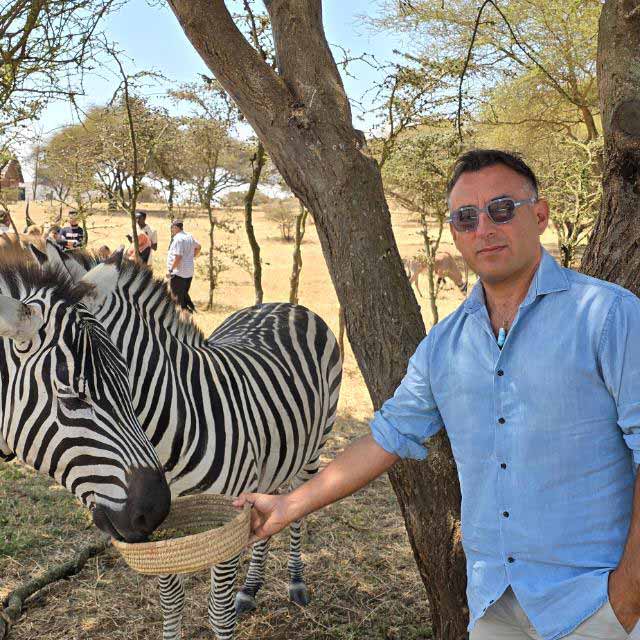
In this video Piergiorgio Pieroni recounts his safari in Tanzania, during which he visited the Serengeti Park, where he had the opportunity to visit a Maasai village, of which he shows us evocative images of this indigenous warrior tribe.
Who are the Maasai
The Maasai tribe, or Maasai, is a Nilotic people, that is, an East African ethnic group speaking Nilotic languages, that is, derived from Nilo-Saharan languages, and living in the highlands between Kenya and Tanzania. Believed to be nomadic, or semi-nomadic, this people is actually composed of transhumant herders, that is, people who move along with their flocks, but these days it is not uncommon to find settled ones, especially in areas of Kenya. Transition, in both herding and agriculture, is a typical feature of life for many indigenous tribes, such as the Arusha People, after whom Arusha National Park is named.
The language spoken by this tribe is called maa, and it is from this that their ethnic group, namely maasai, takes its name. Although it is estimated that there are approximately 100,000 individuals belonging to this tribe, there is no certain date, as there are obviously no censuses. This people is divided into 12 different clans, whose names are Keekonyokie, Damat, Purko, Wuasinkishu, Syria, Laitayiok, Loitai, Kisonko, Matapato, Dalalekutuk, Loodokolani and Kaputiei, but there are also others, classified as minor or sub-clans.
History of the Maasai people
These tribes narrate that their history originated with the first of all Maasai, the Mamasinta, who, by climbing a ravine, gave birth to his people. Scholars believe that this ravine may actually refer to the steep escarpments near Lake Turkana in the Nile Valley in northern Kenya.
The hypothesis that this people came from Egypt, roughly somewhere between the lands of Sudan and Eritrea, is supported by the fact that, just as is the case with typical populations in the North African regions, Maasai women shave everyone’s head and remove the two lower front teeth.
Years ago the Maasai People owned land in the Serengeti Valley. In the 19th and early 20th centuries, they were able to survive and prove to Europeans, especially the British and German settlers, their right to the land they inherited from their ancestors. Unfortunately, they were unable to withstand the onslaught of civilization in the late 20th century. Over the past 30 years, the Maasai have been evicted from much of their land, which has been further reduced by the creation of National Parks, such as Lake Manyara, Ngorongoro and Tarangire.
Tourists, in fact, who come for a safari in Tanzania or Kenya, want to see the wild animals, such as African lions and cudus, and not the evicted Maasai.
Throughout the savannah camps, bungalows, and hotels began to appear, and soon the Maasai People realized is that lions, antelopes, and gazelles were far more important to tourists than they were. Thus left without a livelihood, many of them are engaged in poaching to this day. During our different safari itineraries, however, it will also be possible to visit the Masai Boma village, so you can get in touch with this Tribe, for an unforgettable experience.
Visit Maasai tribes with our safaris
Their culture
The Maasai tribe lives off what they make from raising cattle and other livestock; in fact, they are almost solely pastoralists. Their connection with animals and their herding nature can be seen in their very culture, which is in fact centered on the care of livestock.
The structure of this people is patriarchal, and the elders are the ones who really hold the power, having in fact almost absolute decision-making power regarding the affairs of their clan. The judicial system of this tribe is obviously governed by laws and traditions that are passed down orally, and if two disputants have doubts about the laws, a council of elders steps in to set things right.
Punishments are of various types, although there is no capital punishment and seldom do we get severe ones, which are applied only for murder and disrespect for elders. In most cases fines and apologies are sufficient.
This population relies primarily on a system of rituals, applied to both males and females. Through initiation rituals, elders decide the roles of initiates, and mark all age transitions. The different ages of the Maasai are: initiate, moran (warrior), young elder and elder.
Maasai dwellings and their villages
The Maasai home is always a place of temporary residence. Every 3-4 years, when the pastures are exhausted, the tribe moves to another location and they build a new village. The houses were originally made to last a short time, as this is a nomadic tribe, but now that they have gotten into the habit of staying in the same place for a long time, they have begun to build more durable ones, as you can see in the picture below.
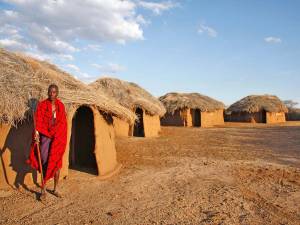
These tribes build small villages in the fields that will house families (between five and seven families) and their livestock. A Maasai village consists of a group of very low huts that are built from small branches and brushwood, supported by a framework of sturdy branches. This is then covered with manure, clay, mud and dry cattle dung. The entire camp is then surrounded by a fence (Kraal) of thorns and thorny bushes in order to keep out lions, leopards and other wild animals. Their huts have no windows, but they do have a fireplace that is located in the center, or near sleeping area. Their beds are on the hard mud floor and covered with animal skins.
While the men take care of the livestock, it falls on the women to build the family home, and since they have no beasts of burden to help them, they have to carry all the materials needed for the work on their shoulders.
Traditionally the staple diet of the Maasai People has been cow’s milk, however when there is a shortage of dairy cows in the village the warriors tend to mix the blood of an animal with its milk. Sometimes they drink the pure blood they extract from a vein, making an incision usually in the bull’s neck and using a gourd as a vessel to contain it . This is supposed to give the warriors great strength. They rarely eat meat; their livestock are considered too valuable for slaughter.
Marriage and social organization
Whenever there is a wedding in the tribe, by tradition, the tribe collectively presents the couple with a cow as dowry. After marriage, the husband may let his wife take care of some cows from his herd, but these still belong to him.
Instead, it is generally the children who take care of the small animals. Starting from the tender age of 3 years, then at a very young age, they keep the cattle and herd around nearby grazing lands. When the children reach the age of 7 to 8 years, they pierce their earlobes with an instrument made from cow horns. The hole gradually expands with fine pieces of wood and, over time, the lobe becomes so elongated, all of which is done not only with wood, but also with heavy ornaments, causing the lobe to elongate to the shoulder. The bigger the hole is in the earlobe, the more the person is respected and considered beautiful.
The number of wives a Masai male has depends on the size of his herd. Women must be fit and strong enough to care for all the animals and children; they are expected to carry water and firewood. Women are considered far less important than their husbands, who are soldiers first, even in peacetime. Men tend to do very little physical work, rather preferring to spend hours in conversation with other warriors on the savannah.
Uses and customs
The relationship of the tribe is based on a strict set of rules. The Tribe itself consists of different groups of men who are all about the same age. The most important event for these young men is the dedication ceremony and circumcision.
After circumcision, the young warriors of the Maasai People leave their homes, armed with spears, sticks and swords to live out their lives on the plains where they can care for their livestock. A warrior who succeeds in killing a lion receives the tribe’s highest honor and is thus entitled to wear a lion mane headband during ritual ceremonies.
After the early start test, the men become like brothers and form a close community. Members of the community must pass a series of tests for advancement in the tribe’s hierarchy, each of which can take up to 15 years to accomplish. They have a kind of ranking that starts with a young warrior then a high ranking warrior, an old warrior, a master warrior – and elders. In the old days a young man in the tribe could not be considered a man until he killed a lion with his spear.
An important attribute of the tribe is the ornaments they wear. Masai men and women spend a lot of time decorating themselves. Women wear their hair short and prefer precious jewelry: long necklaces, earrings, silver, headbands and bracelets. Male soldiers, on the other hand, have long hair.
The Maasai People have lived with nature for thousands of years, and now frantically they are beginning to destroy it. Their livestock can no longer sustain them, now elephants and rhino horns are being sold on the black market, rhinos are on the verge of extinction, and elephant numbers have been drastically reduced.
Today throughout Kenya and Tanzania the Maasai are hired as security guards and work in expensive hotels. Many work to entertain visitors with traditional dances in hotels and theaters.
More and more, you can see people dressed in red robes complete with shields and spears, are standing guard in the perimeters of many luxury hotels that have sprung up in recent years. Only in the remotest corners of the Savannah will you find some nomadic people whose life still remains in its original form, following the ancient ways of life as a once formidable and well-known tribe in East Africa.